Iran war: markets have a short memory for conflict and a long memory for consequence – defence and AI
It’s likely that the Iran war will fade from the front pages, but what it accelerated will not.
Every region of the world is now mobilising for two things at once: defence and AI. Both are metals-intensive, and both are running into the same supply wall. The read-through for ASX-listed resources, particularly small-cap developers, is the most constructive setup we have seen in over a decade.
Olivia Markham, the Perth-born managing director and portfolio manager at US investment giant BlackRock, recently echoed this sentiment, saying it is “one of the most exciting moments in mining I’ve seen in my career”. The artificial intelligence boom, higher defence spending amid greater geopolitical volatility and the electrification of everything as part of the net zero transition will all help the established players at time when there are supply constraints.
The AI boom was as much an energy and metals story as it was a tech story, Markham argued, driven by data centres with a voracious appetite for clean energy as well as copper and critical minerals.
Four expressions of the same demand wave
The war and the AI buildout are themes that feed the same demand curve.
- More EVs, battery energy storage, electrification. The US has run out of room to hedge on lithium and battery supply chains.
- More drones and robots, which means more + better batteries = more specialty alloys and critical minerals.
- More + better weaponry, which is critical-minerals-intensive by definition. An F-35 fighter contains around 427 kg of rare earths; a Virgina-class submarine around 4,200 kg.
- More data centres and AI infrastructure = steel, copper, aluminium, and battery inputs at scale.
Every one of these vectors lands on the same periodic table.
Lithium is the cleanest expression
Lithium sits at the intersection of EVs, stationary storage, drones, and robotics. Recent quarterlies paint a picture.
Albemarle reported continued inventory drawdowns in Q1, with stock levels trending lower through the cycle. Mineral Resources reported sold tonnes above US$2,500/t before spot indices caught up, with management flagging demand strength and supply struggling to keep pace. Core Lithium capitalised on tightening markets by selling 20,000 tonnes of lithium fines to Glencore as opportunistic buying drives the first DSO activity since the 2016/2017 cycle. Liontown is reporting physical tightness with inventories well below one month. Added to this, IGO downgraded Greenbushes FY26 guidance by 10%, a material cut from the world’s largest lithium mine, and lost its CFO in the same window.
We are also seeing increasing direct engagement from South Korean and Japanese offtakers approaching Australian juniors, a sign that conventional supply channels are no longer sufficient. The market is tightening in front of consensus, not behind it.
South Korean and Japanese offtakers are approaching Australian juniors directly because they cannot secure supply through conventional channels. So it seems the market is tightening in front of consensus, not behind it.
The bull market is already moving
The S&P GS Industrial Metals index at all-time highs and the MSCI Global Metals ex-Gold ex-Silver IMI Index breaking to a new interim high, with momentum accelerating into 2026. The ASX 300 Resources index is breaking out of a five-year range relative to the ASX 200. Iron ore is climbing despite consensus calling it lower.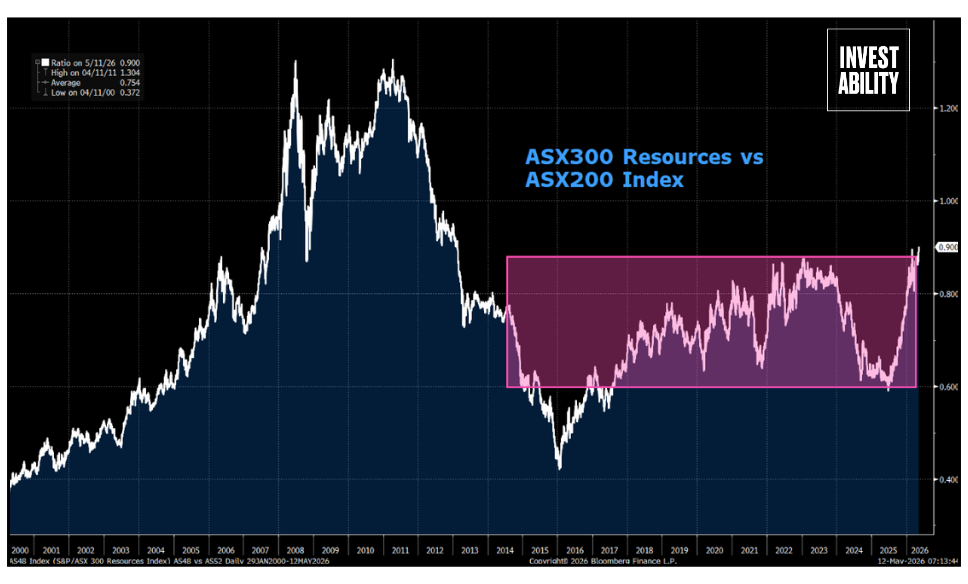 Chart: Relative performance of ASX 300 Resources vs ASX 200 Index
Where the value sits – lithium, copper, gold, silver, rare earths, tungsten and tin
The developer end of the lithium curve is where the asymmetry lies. Producers will rerate, but developers with quality assets, jurisdictional advantage, and proximity to existing infrastructure will rerate harder.
Across copper, the story is similar. The bellwether names have lagged the commodity. Freeport-McMoRan trades around 14% below its 52-week high. Capstone is roughly 28% below its highs and First Quantum still trades well below its 2022 peak, while copper printed a fresh all-time high above 671¢/lb on COMEX this month (May 2026) and the LME set a new closing record above US$13,900/t, with the intraday all-time high of US$14,527/t set in January. Developers with viable, permittable projects in friendly jurisdictions are scarce and getting scarcer. Cobre Panamá shut by court ruling, Grasberg cut 35% on a tailings failure, Peruvian production down 12% on community blockades. Major copper discoveries have collapsed from ~106 in the 1990s (well over half a billion tonnes of copper) to just 14 in the last decade (roughly 46Mt of copper). Mine timelines averaging 17 years. The premium on a permitted, jurisdiction-clean, drill-ready story has rarely been higher.
Gold is the trade that has already worked, and the one most investors remain underweight relative to where it sits. The metal has delivered a generational 50% return, yet typical portfolios still carry low-single-digit exposure. Despite gold being 80% higher since early 2025, global gold ETF holdings sit below the November 2020 peak of approximately 3,929 tonnes. Sprott’s recent commentary suggests the Western institutional re-entry hasn’t happened yet: “When we survey different investor groups, we find that most of them have no exposure to gold at all.” Sustained high prices and expanding cash flows typically draw allocation, but many generalist funds remain underweight gold equities even now. Producers have led the equity response among miners, though even they have lagged the metal, whilst ASX-listed developers with near-term production and explorers with credible paths to resource growth have not yet been fully repriced. The asymmetry has rotated down the curve toward the names that can deliver ounces into a strong price.
Silver is moving with conviction after years of trading as a junior associate to gold. The metal hit an all-time high of US$121.62/oz on January 29, 2026, and even after a sharp retracement, sits well above its long-term range. The industrial bid, solar, electronics, and increasingly defence, is structural rather than cyclical. Silver Institute and Metals Focus are forecasting a sixth consecutive year of structural deficit in 2026, with 762 million ounces drawn from global stockpiles since 2021 to cover the gap. ASX silver exposure is thin compared with North American peer markets, which makes the names that do exist disproportionately leveraged to the move.
The broader critical minerals suite, rare earths, tungsten, antimony, tin, manganese, graphite, tantalum, and the platinum group, is where Western governments are now writing policy in real time, with offtake support, grants, equity stakes, and strategic stockpiling. For example, in July 2025 the US Department of Defense took a 15% equity stake in MP Materials via a $400 million preferred share issuance, added a $150 million loan, and set a decade-long price floor and offtake commitment for the company’s rare earth magnet output. Australia has committed A$1.2 billion to a Critical Minerals Strategic Reserve targeting antimony, gallium and rare earths, operational by H2 2026, with offtake agreements and price floor mechanisms built in. The October 2025 US–Australia Critical Minerals Framework formalises bilateral coordination on capital, offtake and stockpiling for new capacity coming online in 2026. For ASX developers in these commodities, the buyer is increasingly the state, or a strategic partner moving with state backing, which changes the financing equation and shortens the path to production for some projects and reprices the development risk on assets that previously had no obvious offtake counterparty.
What could go wrong
No structural thesis is one-sided. A genuine Iran ceasefire would lift the conflict premium out of copper, gold and silver simultaneously (we saw an early version of this in late May). A weaker-than-expected China property recovery would re-rate iron ore the other way. A US recession would pull industrial demand lower across the base metals complex. And the offtake-led financing story for critical minerals depends on Western policy continuity that is very far from guaranteed. None of these change the supply-side reality, but they could delay the equity rotation timeline by 6 to 12 months. The structural call holds, but the path is unlikely to be linear.
The implication for ASX resources companies
For ASX resources companies, the window to tell a credentialed story to a receptive investor audience is open now. The macro has moved, but the equity rotation is nascent. The companies that get in front of generalist capital with a credentialed story now will be the ones that re-rate when it arrives in force.
Investability advises IPO candidates, ASX-listed boards and management teams on strategic investor relations. If you want to be well placed before the rotation accelerates, get in touch.
Sources
- Benchmark Mineral Intelligence. (2025). Lithium supply chain commentary and market intelligence. https://www.benchmarkminerals.com
- Core Lithium. (2025). Core Lithium sells stockpile to Glencore, eyes Finniss restart. com. https://www.mining.com/web/core-lithium-sells-stockpile-to-glencore-eyes-finniss-restart/
- IGO Limited. (2026). Quarterly activities report https://www.igo.com.au/site/investor-centre/asx-announcements
- London Metal Exchange. (2026). LME copper. https://www.lme.com/en/Metals/Non-ferrous/LME-Copper
- Liontown Resources. (2025). Quarterly activities report. https://ltresources.com.au/investors/asx-announcements/
- Mineral Resources. (2025). March 2025 quarterly report. https://www.mineralresources.com.au/investors/asx-announcements/
- S&P Dow Jones Indices. (2026). S&P GSCI Industrial Metals Index. https://www.spglobal.com/spdji/en/indices/commodities/sp-gsci-industrial-metals
Author: Dannika Warburton
Dannika is Founder and Principal of Investability, an Australian investor relations and media relations consultancy, with over 15 years capital markets experience across investment banking, institutional sales and IR.