Investor relations in 2026: five themes driving the shift from disclosure to trust
Investor relations ensure the market understands the business, prices it on the right information, and continues to provide capital on competitive terms by aligning perception with performance. When it is effective, it lowers the cost of equity, supports register stability through volatility, and gives the board a clear view of how investors are interpreting strategy. The Northern Star campaign shows what happens when it goes missing.
When Elliott Investment Management accumulated a stake worth more than A$1 billion in Northern Star Resources earlier this year, the activist campaign that followed was unusual in one important respect. Elliott’s critique was not centred on disclosure failures, accounting irregularities or regulatory breaches. The information was largely available. What Elliott questioned was management’s ability to execute against it.
The numbers were stark. Seven guidance or operational misses in four years. A two-year total shareholder return of 52% against a peer-group return of 180%, through one of the strongest gold markets in recent history. A share price down roughly 33% year-to-date while gold itself had fallen only around 5% from its highs.
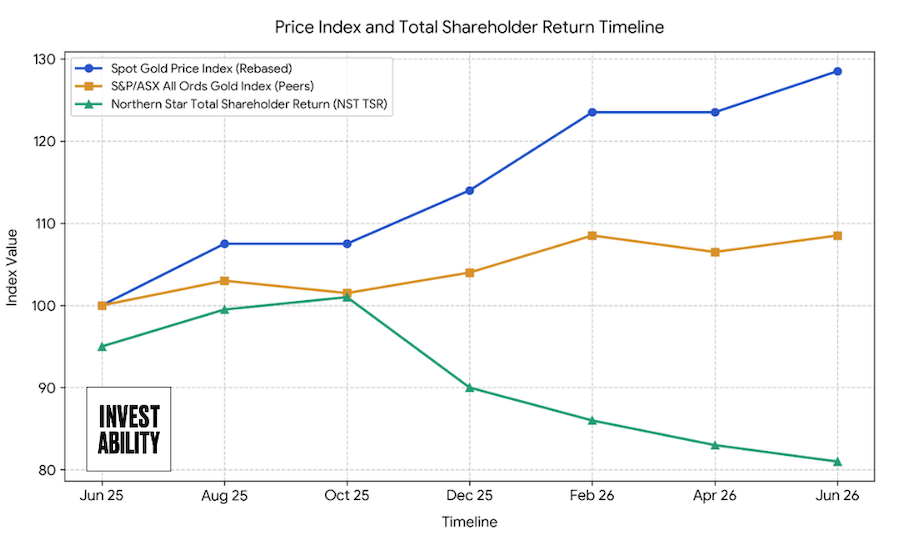
Chart: Relative performance of ASX:NST and Spot Gold Price
Elliott did not accuse Northern Star of hiding anything. It accused management of failing to do what it said it would. The investors who backed the campaign were not asking “What happened?” They were asking “Can we trust this team to deliver what it says will happen next?” That is the question facing every IR function on the ASX, and it is not answered with another announcement. It is answered through consistent execution, transparent communication and disciplined capital allocation, repeated until the market stops discounting the promise and starts pricing the track record. The five themes below are where that work happens in the year ahead.
As information becomes increasingly abundant through AI tools, real-time data platforms and expanding disclosure requirements, the scarce commodity in investor relations is no longer information itself. The five themes below reflect a single structural shift in investor relations from an information function to a trust function.
1. AI: Powerful Tool, Dangerous Expert
Irwin’s 2026 State of IR report found that 42% of IR teams are actively using AI, up from just 6% a year earlier. The productivity gains are real, but a big theme of the year ahead will be the governance risk AI poses, which is more structural than most teams currently price in.
The Australian Institute of Company Directors has been clear that directors cannot treat AI-generated summaries as a substitute for their own review. Anything entered into a public large language model should be treated as having left the company’s information barrier.
Two practical risks stand out. The first is earnings commentary drafted by AI that drifts away from the disclosed financial statements, sentence by sentence. Continuous disclosure obligations apply to whatever language reaches the market, regardless of who or what drafted it. The second is perception reporting assembled from AI summaries of broker notes, where nuance is compressed and then presented to the board as established fact. When ASIC asks how a decision was reached, the board minute is what counts, and “the AI said so” is not a defence.
- Treat anything an LLM touches as market communication. A human decision, recorded in the board minute, should sit behind it.
2. Narrative: Stop Sending Activity Logs
50% of mid-cap respondents in a recent IR survey ranked the equity narrative as their top IR priority for the year ahead. Yet you’d be hard pressed to find a narrative in most ASX small and mid-cap announcements.
Sophisticated investors have largely stopped asking what you did. They are asking where value will be created over the next twelve to twenty-four months, what assumptions sit behind that, and how capital will be allocated to deliver it. This is where investor relations shifts from an information exercise to a question of trust, earned by saying what you will do and then doing it.
The Northern Star situation made the point. Elliott’s case was built on the gap between what management said would happen and what actually did, repeatedly, over four years. An activity log cannot close that gap. A credible investment thesis, consistently updated and tested against outcomes, can.
- Align narrative with execution, not activity. Every disclosure should reinforce a testable investment thesis that can be validated against outcomes over time.
- Stress-test messaging against investor disbelief. Actively test strategy, guidance and capital allocation assumptions through the lens of an activist or sceptical institutional investor.
3. ESG: Not “Not Important” in Australia
Around half of North American IR professionals, 52% in recent global data, say ESG matters little to their investor base. That number does not carry across to Australia, where the regulation has moved firmly in the other direction. Mandatory climate disclosure is phasing in by company size. Group 1, the largest entities above A$500 million in revenue, A$1 billion in assets, or 500 employees, is already reporting. Group 2 follows from 1 July 2026, covering companies above roughly A$200 million in revenue, A$500 million in assets, or 250 employees. Group 3 starts from 1 July 2027, scaling down to A$50 million in revenue, A$25 million in assets, or 100 employees.
Most ASX small-cap resources companies sit in Group 2 or 3, with first reports due in 2027 or 2028. The temptation to treat that as a “later” problem is the trap, because the disclosure decisions that will sit in those reports are being made now, within capital allocation, project selection and asset-level emissions assumptions.The cost of getting the language wrong is no longer theoretical. The Federal Court has ordered greenwashing penalties of A$11.3 million against Mercer Super, A$12.9 million against Vanguard and A$10.5 million against Active Super, and ASIC commenced a fourth action in October 2025, signalling that it is broadening its scope rather than narrowing it. The practical response is to drop the generic sustainability adjectives and tighten the disclosures that are genuinely material.
- Make the call now, in capital allocation, not later in the report. The disclosure only records a decision you have already made
4. Compliance: What Would Jesus Do?
In March 2025, James Hardie Industries announced it would acquire The AZEK Company, a leading US manufacturer of premium outdoor living products, in a US$8.75 billion deal funded partly by issuing scrip equivalent to roughly 35% of its capital. No shareholder vote was required. The ASX granted a waiver in line with its standing guidance, and the board acted within the rules.
However Hardie shares fell more than 11%. AustralianSuper, UniSuper, Allan Gray, Schroders, Fidelity and Ownership Matters wrote publicly to the ASX. Fitch placed the company on negative watch. By October 2025, the ASX had published a consultation paper proposing to reduce the scrip issuance cap from 100% of issued capital to 25% for S&P/ASX 300 companies.
What happened was not a disclosure breach, but a judgement failure dressed in a clean compliance record. For directors, the test is no longer “can we?” It is “what do our top twenty holders expect us to do?”
- Treat top shareholders as a governance input, not an audience. Engagement with the top 10–20 holders should shape strategic decisions, not just communicate them after the fact.
5. Measurement: You Cannot Improve What You Do Not Measure
One in three IR teams runs without formal KPIs, and among those that have them, only a quarter believe their KPIs capture real impact. That is a weak base to improve from. Five metrics actually matter, and they should anchor the IR program in the year ahead.
- Register quality. Movement of long-only institutional ownership as a share of free float, which shows whether quality capital is upgrading in or rotating out.
- Sell-side dispersion. The spread of broker price targets and consensus earnings or NPV. Tight dispersion means the market shares a coherent view of value, while wide dispersion means the story is not landing.
- Targeting conversion. Meetings held versus new positions taken. Conversion that sits at the bottom of the range usually points to a targeting problem rather than a lack of access.
- Disclosure incidents. ASX queries, corrections and clarifications. Zero is achievable and sustaining it signals real communication discipline.
- Capital access. Cost of capital and equity-raising capacity relative to peers, the ultimate external verdict on the equity story.
Most strong IR functions track five to seven of these in the board pack. The table below sets out where mid-caps typically sit, and what a high-quality signal looks like.
| Metric | Observed Mid-Cap Range | Strong / High-Quality Signal |
| Register quality (long-only % of free float, 24-month drift) | ±2–10% volatility | Net long-only inflow |
| Sell-side dispersion (spread of broker targets / consensus) | 10–35% | <10–15% |
| Targeting conversion (meetings to new positions) | 5–20% | >25% sustained |
| Disclosure incidents (ASX queries per year) | 0–3 | Consistently zero |
| Capital access (cost-of-equity premium vs peers) | +200–500bps | Converging to sector median |
| Register quality (long-only % of free float, 24-month drift) | ±2–10% volatility | Net long-only inflow |
| Sell-side dispersion (spread of broker targets / consensus) | 10–35% | <10–15% |
| Targeting conversion (meetings to new positions) | 5-20% | >25% sustained |
The Common Thread
Elliott did not accuse Northern Star of hiding information. It accused management of failing to deliver on what it said. The investors who backed that campaign were not asking “What happened?” They were asking “Can management be trusted to deliver what it says will happen next?”
That is the question every IR function on the ASX is now being asked. Across all five themes, the advantage accrues to the companies the market trusts to do what they said they would.
Work with Investability
Investability advises ASX-listed boards and management teams on investor relations strategy, disclosure discipline, equity narrative development and institutional engagement. If you are reviewing your IR function ahead of FY26 reporting, a capital raise or upcoming transactional activity, we should talk.
Sources
- [1] Reuters, “Elliott takes A$1 billion stake in Australia’s Northern Star, calls for strategic review” (June 2026), https://www.reuters.com/legal/transactional/elliott-takes-a1-billion-stake-australias-northern-star-calls-strategic-review-2026-06-01/
- [2] Herbert Smith Freehills Kramer, “The James Hardie / Azek merger, investor backlash and ASX’s response” (May 2025), https://www.hsfkramer.com/insights/2025-05/the-james-hardie-azek-merger-investor-backlash-and-asxs-response
- [3] Kodari Securities, “James Hardie Faces Backlash on Azek Acquisition and NYSE Shift” (April 2025), https://kosec.com.au/james-hardie-hit-by-investor-backlash-over-8-75b-azek-deal-and-nyse-move/
- [4] Clayton Utz, “Shareholder say is back: ASX’s consultation on dilutive deals, delistings and the new mood of investor activism” (December 2025), https://www.claytonutz.com/insights/2025/december/shareholder-say-is-back-asx-s-consultation-on-dilutive-deals-delistings-and-the-new-mood-of-investor-activism
- [5] ASX, Guidance Note 8: Continuous Disclosure, https://www2.asx.com.au/content/dam/asx/rules-guidance-notes-waivers/asx-listing-rules/guidance-notes/gn08-continuous-disclosure.pdf
- [6] ASIC, Regulatory Guide 62: Better Disclosure for Investors, https://download.asic.gov.au/media/1239051/rg62.pdf
- [7] Irwin, “The State of Investor Relations in 2026” (February 2026), based on survey of 223 IR professionals, https://www.getirwin.com/blog/the-state-of-investor-relations-in-2026
- [8] Ashurst, “Wait AZEK – is this too much change?” (October 2025), https://www.ashurst.com/en/insights/wait-azek-is-this-too-much-change/
- [9] Australian Institute of Company Directors (AICD), Insights Snapshot: AI Use by Directors and Boards (2025), https://www.aicd.com.au/content/dam/aicd/pdf/news-media/research/2025/ai-use-by-directors-and-boards.pdf
- [10] ASIC, “24-205MR ASIC urges businesses to prepare for mandatory climate reporting” (September 2024), https://asic.gov.au/about-asic/news-centre/find-a-media-release/2024-releases/24-205mr-asic-urges-businesses-to-prepare-for-mandatory-climate-reporting/
- [11] ASIC, Climate-related financial disclosure implementation timeline (as referenced in media release above)
- [12] Federal Court of Australia, Mercer Super proceedings (greenwashing findings and penalty outcome)
- [13] Federal Court of Australia, Vanguard Investments Australia proceedings (greenwashing findings and penalty outcome)
- [14] Federal Court of Australia, Active Super proceedings (greenwashing enforcement action, 2023–2025)